Last Updated by the Serious Play Business Content Team on May 14, 2025.
This article sits alongside a companion piece on organizational alignment workshops published at play4business.com. The two articles cover connected dimensions of strategic facilitation — alignment and transformation — and are best read together. For the full methodology context behind both, visit seriousplaybusiness.com.
Change Readiness Workshops: Using LEGO® SERIOUS PLAY® to Navigate Organizational Transformation
Executive Summary
Change readiness workshops help organizations understand how employees perceive transformation, uncertainty, and operational risk. Many change initiatives fail because leadership communication does not fully address emotional, structural, and cultural resistance patterns. The LEGO® SERIOUS PLAY® Method helps organizations surface hidden concerns, visualize systemic barriers, and improve participation across transformation programs. In 2026, organizations increasingly use structured strategic facilitation methods because conventional change communication often produces compliance without commitment.
For consultants and HR professionals leading transformation initiatives, change readiness workshops create a practical framework for understanding organizational resistance. For leadership teams, the method offers a structured way to build collective understanding before major operational changes begin. The phrase change readiness workshops appears more frequently in organizational strategy discussions during 2026 because leadership teams recognize that transformation success depends on participation quality, not communication volume alone.
Change readiness workshops using LEGO® SERIOUS PLAY® improve transformation outcomes because participants build visible models of fears, assumptions, and organizational pressures that traditional discussions frequently leave hidden. The methodology supports deeper participation, systems awareness, and collaborative problem solving during periods of uncertainty. Organizations using shared modeling approaches often identify resistance patterns earlier and strengthen implementation readiness.
What Change Readiness Means in Organizations
Change readiness is an organization’s capacity to understand, absorb, and operationalize transformation without creating destructive confusion or resistance. When readiness remains low, employees interpret change through uncertainty, which leads to defensive behavior and reduced engagement.
Organizations often assume resistance exists because employees dislike change itself. Resistance frequently develops because organizations fail to create shared understanding around purpose, consequences, and operational impact.
Employees resist transformation less because of the change itself and more because organizational ambiguity increases perceived personal and operational risk.
Within organizational change initiatives, readiness emerges from interconnected systems involving leadership trust, communication consistency, role clarity, incentive structures, and psychological safety.
Transformation programs frequently create hidden feedback loops. Unclear communication increases uncertainty. Uncertainty increases informal speculation. Informal speculation weakens trust and reduces participation.
Organizations implementing large-scale transformation initiatives can experience 20–40% productivity disruption during poorly managed transition periods.
The Cost of Low Change Readiness
Low change readiness weakens organizational execution because employees spend cognitive energy managing uncertainty rather than focusing on implementation.
Organizations with weak readiness commonly experience:
- Reduced engagement
- Slower adoption rates
- Informal resistance networks
- Leadership credibility erosion
- Conflicting operational behaviors
- Increased turnover risk
Many transformation failures occur because leadership teams overestimate communication effectiveness while underestimating emotional and structural complexity.
Operational friction increases when departments interpret change priorities differently, which creates inconsistent implementation across teams.
Managers often become bottlenecks during transformation because they receive insufficient space to process strategic implications before communicating change downstream.
Organizations frequently lose momentum during transformation initiatives because unresolved uncertainty spreads through informal organizational networks faster than official communication.
Why Traditional Change Workshops Underperform
Traditional change workshops often prioritize information transfer instead of collective meaning-making. Leaders present slides, explain timelines, and communicate goals, but employees remain passive recipients.
Passive workshop formats reduce ownership because participants consume information without actively constructing understanding.
Conventional workshops also struggle to surface hidden concerns. Employees may avoid voicing uncertainty publicly due to hierarchy, political sensitivity, or fear of appearing resistant.
Without structured reflection processes, organizations mistake silence for agreement.
Another challenge involves abstraction. Leaders discuss culture, transformation, innovation, or agility without helping participants externalize how those concepts affect operational reality.
Transformation communication becomes ineffective because abstract messaging rarely changes behavior without shared interpretation.
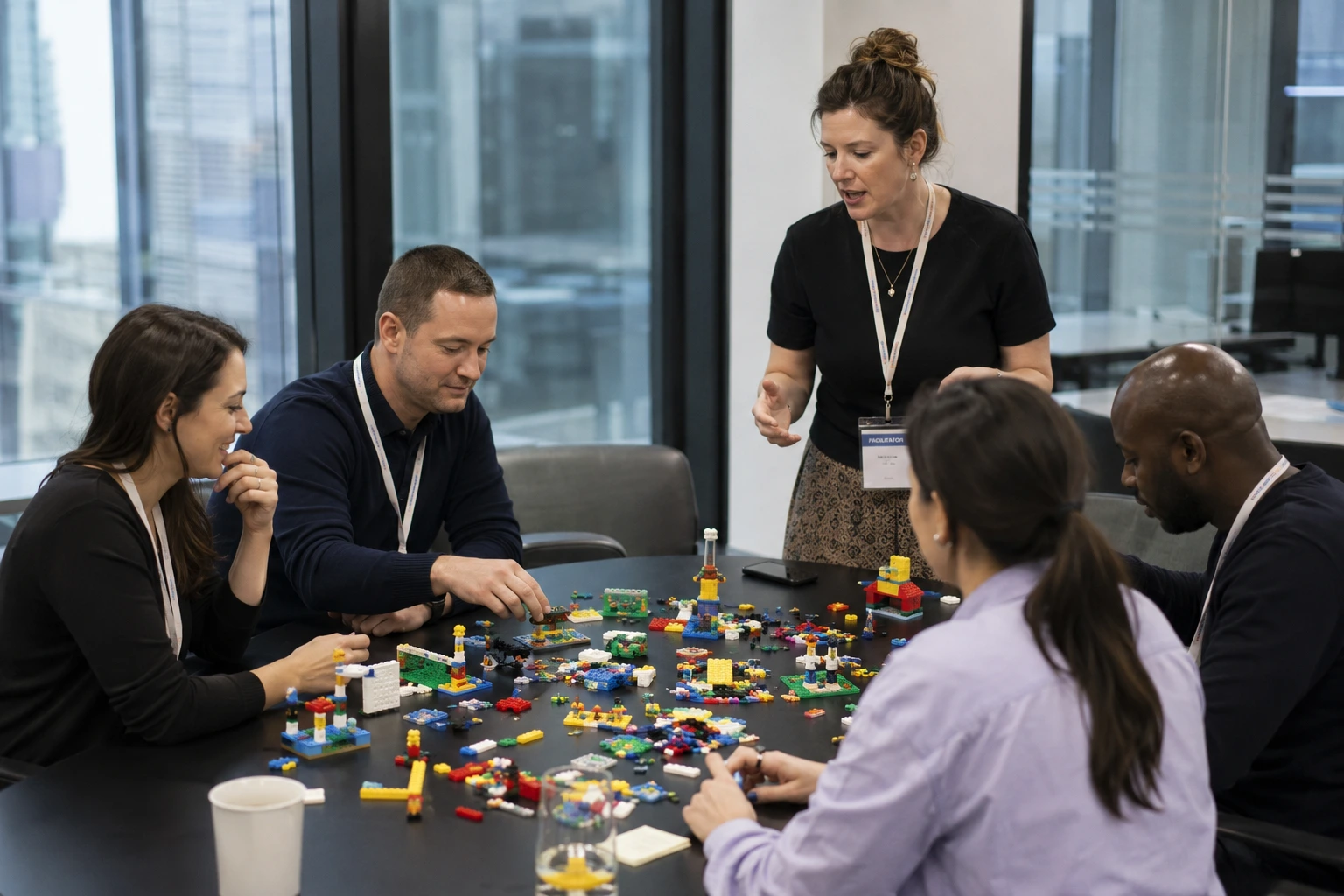
The LEGO® SERIOUS PLAY® Method creates stronger participation by helping employees model organizational realities physically and metaphorically. To explore the broader methodological foundation, review “how the LEGO® Serious Play® Method works” at Serious Play Business.
The Methodological Foundation of LEGO® SERIOUS PLAY® in Change Contexts
The LEGO® SERIOUS PLAY® Method is a structured facilitation methodology designed to improve participation, reflection, systems thinking, and collaborative insight generation.
The methodology supports organizational transformation because participants build representations of current pressures, future concerns, and desired outcomes using metaphorical models.
Visible models improve change conversations because employees can discuss organizational realities indirectly through the model rather than defending personal opinions.
The process emphasizes 100% participation and structured storytelling. Every participant contributes regardless of hierarchy or communication style.
In leadership development contexts, the methodology supports deeper reflection because tactile construction activates cognitive pathways often underused in conventional workshop environments.
The four-step facilitation structure commonly includes:
- Facilitator prompt
- Individual model construction
- Storytelling and explanation
- Group reflection and systems analysis
Shared modeling improves organizational trust because employees experience participation rather than top-down communication.
Serious Play Business frequently applies these methods in transformation environments involving mergers, restructuring, digital change, leadership transition, and culture integration.
How LEGO® SERIOUS PLAY® Improves Change Readiness Workshops
Change readiness workshops using LEGO® SERIOUS PLAY® help organizations visualize hidden resistance, competing assumptions, and structural barriers.
When participants construct models of organizational reality, leadership teams gain insight into concerns that conventional surveys or presentations may never reveal.
The methodology strengthens change readiness through several mechanisms:
Psychological Safety
Participants discuss models rather than defending personal positions directly.
Systems Visibility
Teams identify interdependent organizational forces influencing transformation success.
Shared Interpretation
Employees develop common language around transformation priorities.
Participation Equity
Structured facilitation reduces dominance by senior voices.
Strategic Reflection
Participants explore future-state implications before implementation accelerates.
Organizations using structured strategic facilitation during transformation often identify operational barriers earlier, reducing downstream implementation friction.
As part of facilitator certification journeys, facilitators learn how to manage emotionally sensitive conversations while maintaining methodological rigor and strategic focus.
Workshop Example: Change Readiness Workshop Structure
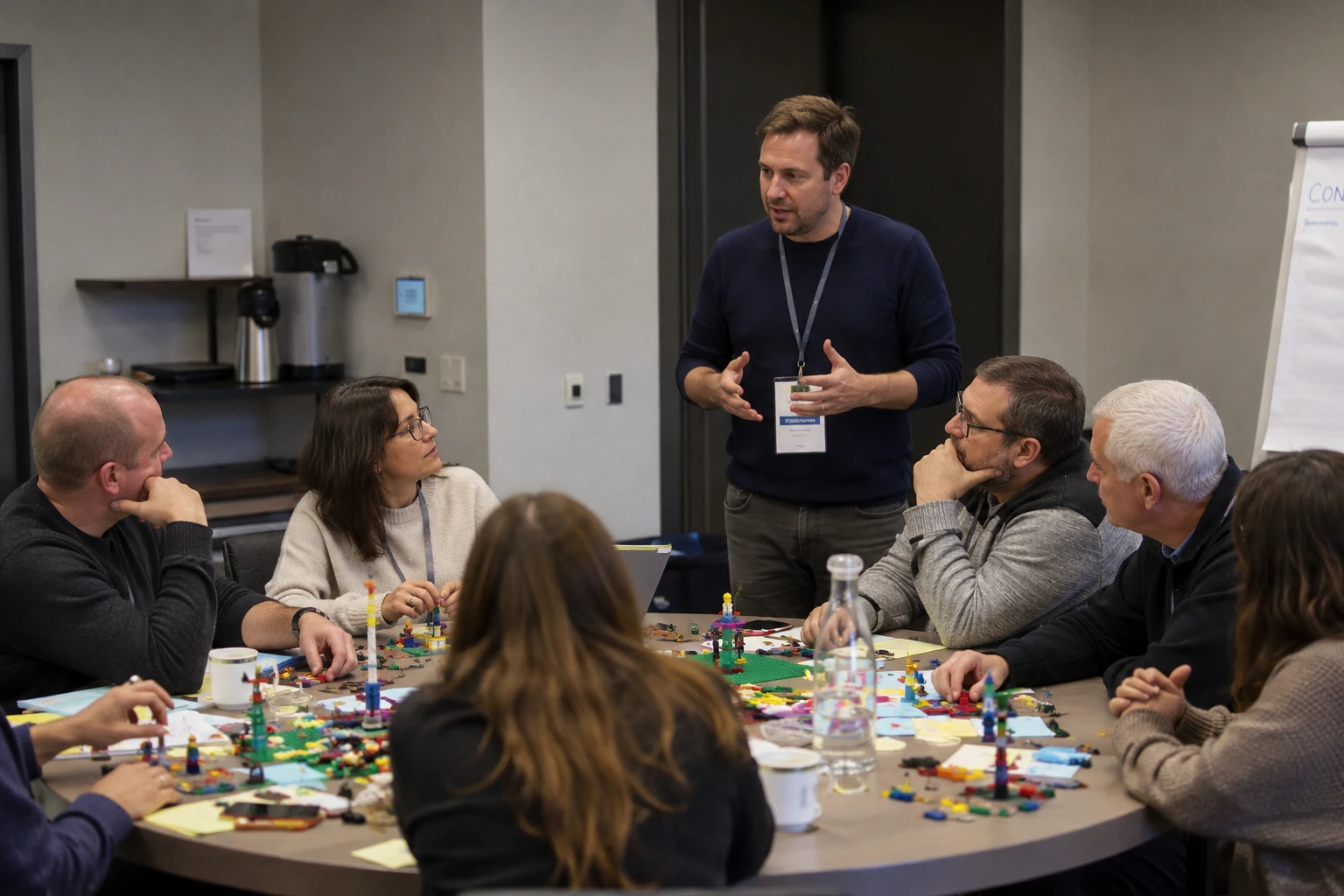
Below is a representative workshop structure used in organizational transformation environments.
Click the ‘+’ button below to explore the detailed workshop stages.
1. Current-State Reality Modeling & 2. Resistance Pattern Mapping
Step 1 — Current-State Reality Modeling (20–30 minutes): The facilitator prompts participants to build models representing the organization’s current change environment. Participants build silently before sharing stories connected to uncertainty, pressure, opportunity, or resistance. The facilitator prompts questions such as: What currently creates uncertainty? Where does communication break down? Which barriers threaten successful implementation?
Step 2 — Resistance Pattern Mapping (30–45 minutes): Participants identify factors weakening readiness. The facilitator guides reflection around emotional, operational, and structural resistance drivers. Groups frequently discover that resistance emerges from unclear processes rather than opposition to organizational goals.
3. Shared Future-State Construction & 4. Transition Scenario Exploration
Step 3 — Shared Future-State Construction (45–60 minutes): Participants build shared models representing a successful transformation outcome. Connections between leadership behavior, communication systems, culture, and operational execution become visible. The facilitator prompts participants to identify: critical dependencies, leadership responsibilities, communication priorities, cultural enablers, and structural risks.
Step 4 — Transition Scenario Exploration (30–45 minutes): The group tests different transformation scenarios by modifying the shared model. Scenario testing improves readiness because participants visualize consequences before operational disruption escalates.
5. Strategic Action Commitments
Step 5 — Strategic Action Commitments (20–30 minutes): Participants define practical next steps, ownership structures, and communication responsibilities. The facilitator closes by linking workshop insights to ongoing strategic facilitation, leadership alignment, and implementation planning.
Comparing LEGO® SERIOUS PLAY® With Conventional Change Management Workshops
Traditional change workshops often emphasize communication delivery. LEGO® SERIOUS PLAY® emphasizes participation, systems visibility, and shared meaning creation.
Conventional formats frequently create informational awareness without emotional or operational ownership.
LEGO® SERIOUS PLAY® workshops improve change readiness because participants actively construct interpretations rather than passively receiving executive messaging.
Traditional workshops commonly produce:
- Passive listening
- Limited psychological safety
- Hidden resistance patterns
- Weak cross-functional insight
By contrast, structured strategic facilitation encourages visible systems analysis, collaborative reflection, and stronger participation equity.
For organizations looking to hire a facilitator, transformation workshops increasingly require methods capable of navigating ambiguity, emotion, and structural complexity simultaneously.
Outcomes and Strategic Relevance
Change readiness workshops generate value when organizations transform uncertainty into coordinated action.
Effective workshops frequently produce:
Earlier Resistance Identification
Leadership teams uncover hidden concerns before implementation breakdowns escalate.
Stronger Cross-Functional Communication
Departments develop shared interpretation around transformation goals and operational priorities.
Increased Participation Quality
Employees contribute insights more openly because facilitation structures reduce hierarchy pressure.
Better Transition Planning
Organizations identify operational dependencies and communication risks earlier.
Improved Leadership Credibility
Leaders demonstrate listening behavior rather than relying exclusively on top-down messaging.
Organizations strengthen transformation capability when communication systems, leadership behavior, and operational structures reinforce participation and clarity.
Transformation success depends less on presentation quality and more on whether employees collectively understand how change reshapes organizational reality.
Serious Play Business supports global organizations through strategic facilitation, facilitator certification, and transformation workshop design focused on sustainable organizational change.
Transform Your Strategy Conversations
To understand the full methodology behind every workshop described in this article, explore how LEGO® SERIOUS PLAY® supports transformation at Serious Play Business.
To understand the full methodology behind the workshop design described above, read what LEGO® Serious Play® is and how it works.
Frequently Asked Questions
What are change readiness workshops?
Change readiness workshops are structured facilitation sessions designed to help organizations assess and strengthen their capacity for successful transformation.
How do change readiness workshops use LEGO® SERIOUS PLAY®?
Change readiness workshops use LEGO® SERIOUS PLAY® by helping participants build metaphorical models representing organizational pressures, resistance patterns, and future-state goals.
Why do employees resist organizational change?
Employees resist organizational change because uncertainty, unclear communication, and perceived operational risk often weaken trust and participation.
What is the LEGO® SERIOUS PLAY® Method?
The LEGO® SERIOUS PLAY® Method is a structured facilitation methodology that uses storytelling, reflection, and model building to improve organizational communication and systems understanding.
How does facilitator certification support transformation programs?
Facilitator certification supports transformation programs because certified facilitators learn how to manage systems thinking, workshop sequencing, participation dynamics, and organizational complexity.