Last Updated on June 15, 2026.
LEGO® SERIOUS PLAY® Certification Explained: Skills, Myths, and Real Value in 2026
Executive Summary
More and more organizations turn to facilitated dialogue. They use it to resolve misalignment, unlock innovation, and work through leadership challenges. As demand rises, many professionals come across LEGO® SERIOUS PLAY® certification. However, they often lack a clear sense of what it stands for. They may also wonder which skills it builds, or how it compares to common assumptions about facilitator credentials.
So this article lays out what LEGO® SERIOUS PLAY® certification is and the capabilities it develops. In addition, it covers the things it is frequently mistaken for. Above all, it explains why capable facilitation now shapes whether teams stay aligned. The intention is simple clarity. In short, it draws the line between certificate marketing and the facilitation skill that actually makes a session work.
LEGO® SERIOUS PLAY® certification develops the capability to design and facilitate structured workshops that surface assumptions, increase participation, and create shared understanding across organizations. In short, think of it as a facilitation skill set — not a product license, and not proof of expertise by itself.
What Does LEGO® SERIOUS PLAY® Certification Actually Mean?
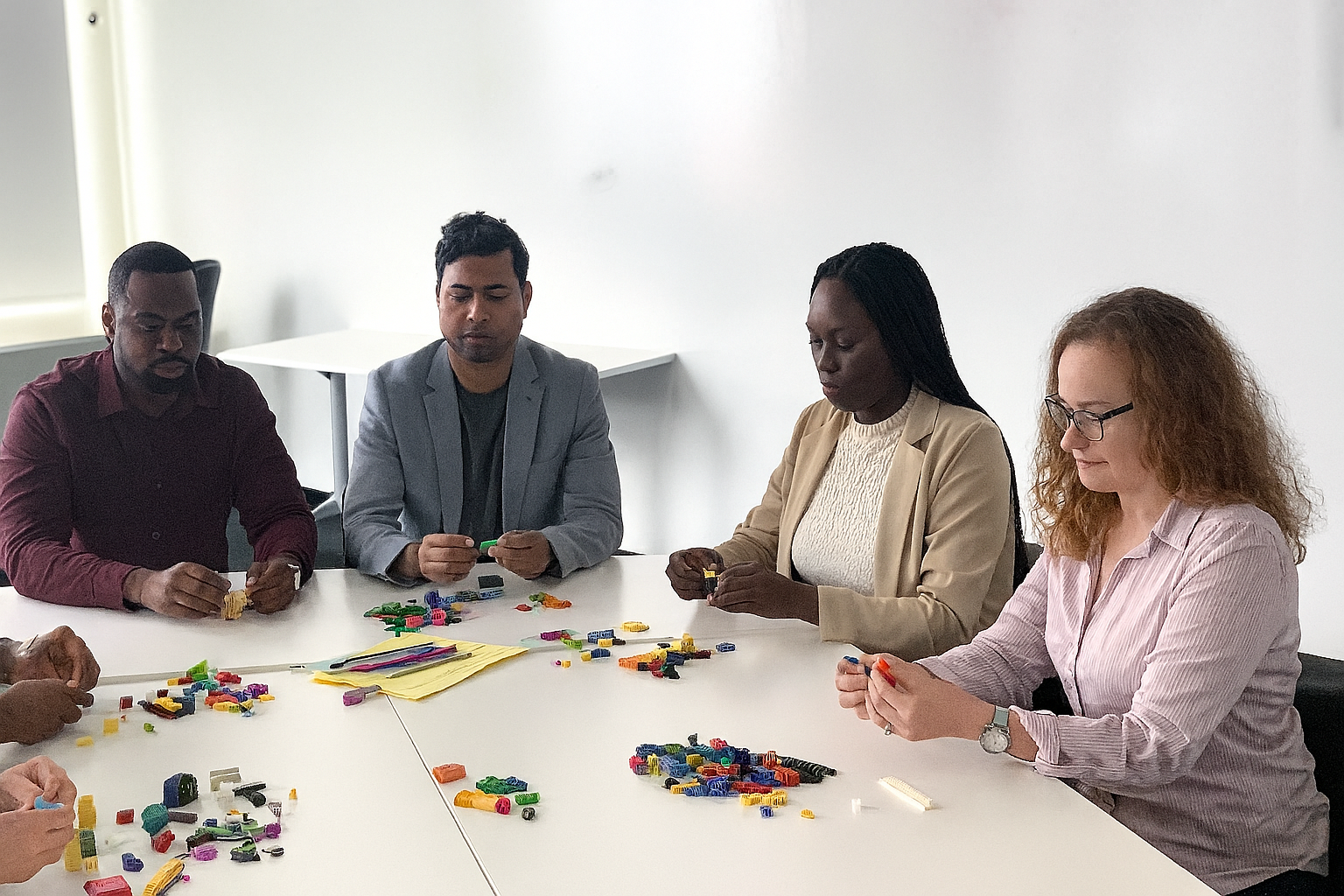
At its core, the certification confirms two things. First, a facilitator has been trained in the LEGO® SERIOUS PLAY® method. Second, they are equipped to run structured, hands-on sessions with it. However, the value lies neither in the bricks nor in ticking off a syllabus. Instead, it lies in being able to design and lead the right kind of session. In these sessions, every participant builds something, talks through it, and links their thinking to everyone else’s. As a result, the group moves beyond open conversation alone.
A Skill Set, Not a List of Course Features
Most pages selling certification lead with what’s in the course. For example, they list the hours, the modules, the materials, and the timetable. Useful as that is, it describes the packaging rather than the payoff. Instead, the real result of certification is a working facilitation skill. Specifically, it is the trained ability to frame a question well and invite individual builds. Then the facilitator surfaces the meaning behind them. Finally, they steer the group toward a model everyone helped shape.
What the Credential Signals
Holding the certification tells people two things. First, a facilitator grasps the logic the method runs on. Second, they can put it to use deliberately. For instance, they set the right challenge, order the build steps, and steer the discussion. As a result, reserved participants contribute as much as the confident ones. Ultimately, the credential marks readiness to facilitate. In other words, it is the opening move in genuine practice, not the final whistle.
The Rising Demand for Skilled Facilitators
Weak facilitation rarely shows up as a line item. Yet leaders run into its effects constantly. For example, meetings keep relitigating the same points. Meanwhile, decisions never quite land. Worse, the “agreement” dissolves the moment everyone walks out. Typically, the mechanics repeat. First, a handful of assertive voices take over. Then the assumptions that matter go unsaid. Finally, the group signs off on a plan that not everyone has truly grasped.
In unstructured sessions, a minority of participants often absorbs most of the talking time. In fact, it frequently lands around 60–75%. Meanwhile, everyone else stays quiet or defers. Moreover, that lopsided participation has a tail. Because the unvoiced disagreement resurfaces later, decisions slip. As a result, weeks can pile onto a timeline that a single well-run session could have closed. Therefore, skilled facilitation exists to shut that gap.
An uneven room doesn’t arrive at consensus. Instead, it arrives at the view of whoever talked the most. By contrast, structured facilitation draws input from every person present.
The Skills LEGO® SERIOUS PLAY® Certification Builds
Certification training cultivates a particular cluster of facilitation skills. Above all, these skills center on how people reason when their hands are busy. Below are the capabilities a certified facilitator learns to put into practice.
Thinking With Your Hands
The method rests on a simple observation. Specifically, people express ideas more honestly when they build a model first and explain it afterward. Because of this, certification trains facilitators to set the right challenges. As a result, abstract questions about strategy, culture, or risk become something a person can construct and then describe.
Shared Models and Full Participation
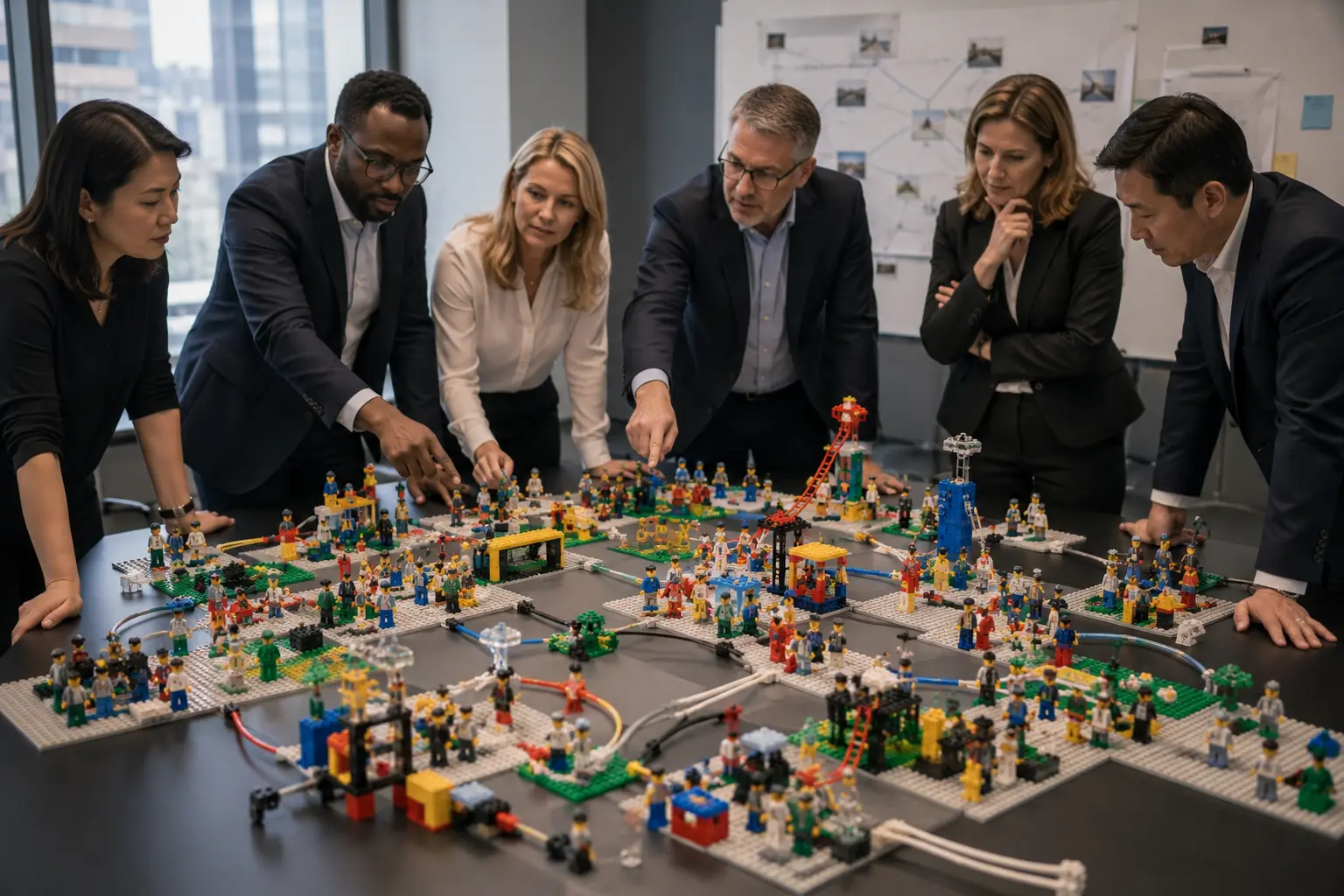
One of the method’s signatures is simple. That is, everyone builds, and everyone speaks to what they built. Therefore, certification covers techniques that make full participation the standard rather than a happy accident. In addition, these techniques fold individual models into one shared model the group collectively owns. Here, strategic facilitation meets systems thinking. As a result, a group sees not only separate viewpoints but how they fit into a single picture of the organization.
That capability stands on the method’s underlying principles. For a thorough walk-through of the thinking behind these sessions, read The LEGO® Serious Play® Method Explained.
Common Misconceptions About LEGO® SERIOUS PLAY® Certification
This is the part most certification pages quietly skip. However, it safeguards both facilitators and the organizations hiring them. In fact, being honest about the edges of the credential is exactly what makes it trustworthy.
It Isn’t a Credential From the LEGO Group
Being certified in the method does not mean a facilitator has been certified, hired, or endorsed by the LEGO Group. Rather, LEGO® SERIOUS PLAY® is a facilitation methodology. Therefore, finishing training in it creates no formal tie to the toy company. Likewise, it implies no sponsorship of a facilitator’s work.
It Isn’t a License or a Stamp of Expertise
Certification is not a regulatory license. Moreover, on its own it doesn’t make anyone an expert. Instead, it confirms that a facilitator has been trained in the method. Genuine expertise builds up only through running sessions again and again. For example, a facilitator learns to sense the mood of a room and recover when a build stalls. Over time, they also reshape the design to fit the challenge at hand. So a certificate opens that road. However, it isn’t a receipt for having finished it.
A credential verifies training. By contrast, competence is won in the room. Specifically, it comes through repeated, reflective facilitation practice.
It Won’t Make Sessions Succeed Without Practice
No certificate removes the need to prepare and rehearse. After all, a strong session leans on a well-framed challenge and a sensible sequence. It also leans on a facilitator who can keep the process steady. For instance, a group sometimes falls silent or wanders off-course. In short, certification supplies the tools. However, practice is what turns those tools into dependable results.
Conventional Workshops vs LEGO® SERIOUS PLAY® Sessions
The simplest way to grasp what certification develops is to compare two formats. So set an ordinary workshop beside a LEGO® SERIOUS PLAY® session. The difference isn’t the bricks. Rather, it’s what the format does to participation, to assumptions, and to shared understanding.
| Conventional Workshop | LEGO® SERIOUS PLAY® Session |
|---|---|
| Talk-based discussion | Thinking through built models |
| Some people participate | Everyone participates |
| Assumptions stay hidden | Assumptions are made visible |
| Separate individual views | One co-created shared model |
How Certified Facilitation Strengthens Organizational Alignment
Alignment problems seldom come down to a shortage of brains or good intentions. Instead, they come from assumptions that never surface. For example, people nod along to the same words while privately meaning different things. Therefore, a certified facilitator’s central task is to bring those assumptions into the open. As a result, a team can settle them on purpose, rather than tripping over them halfway through delivery.
That skill maps straight onto the work leaders care about most. For instance, in leadership and culture, it exposes the unspoken priorities pulling a team apart. Similarly, in innovation and change, it hands every contributor a way to get an idea on the table. As a result, the loudest or most senior people no longer dominate. Finally, in strategy, it converts a pile of opinions into one shared model. Then the team can actually commit to it and act together.
Because assumptions are built into a shared model, disagreement turns visible and discussable. Otherwise, it lies low until delivery falls over.
What a LEGO® SERIOUS PLAY® Session Looks Like
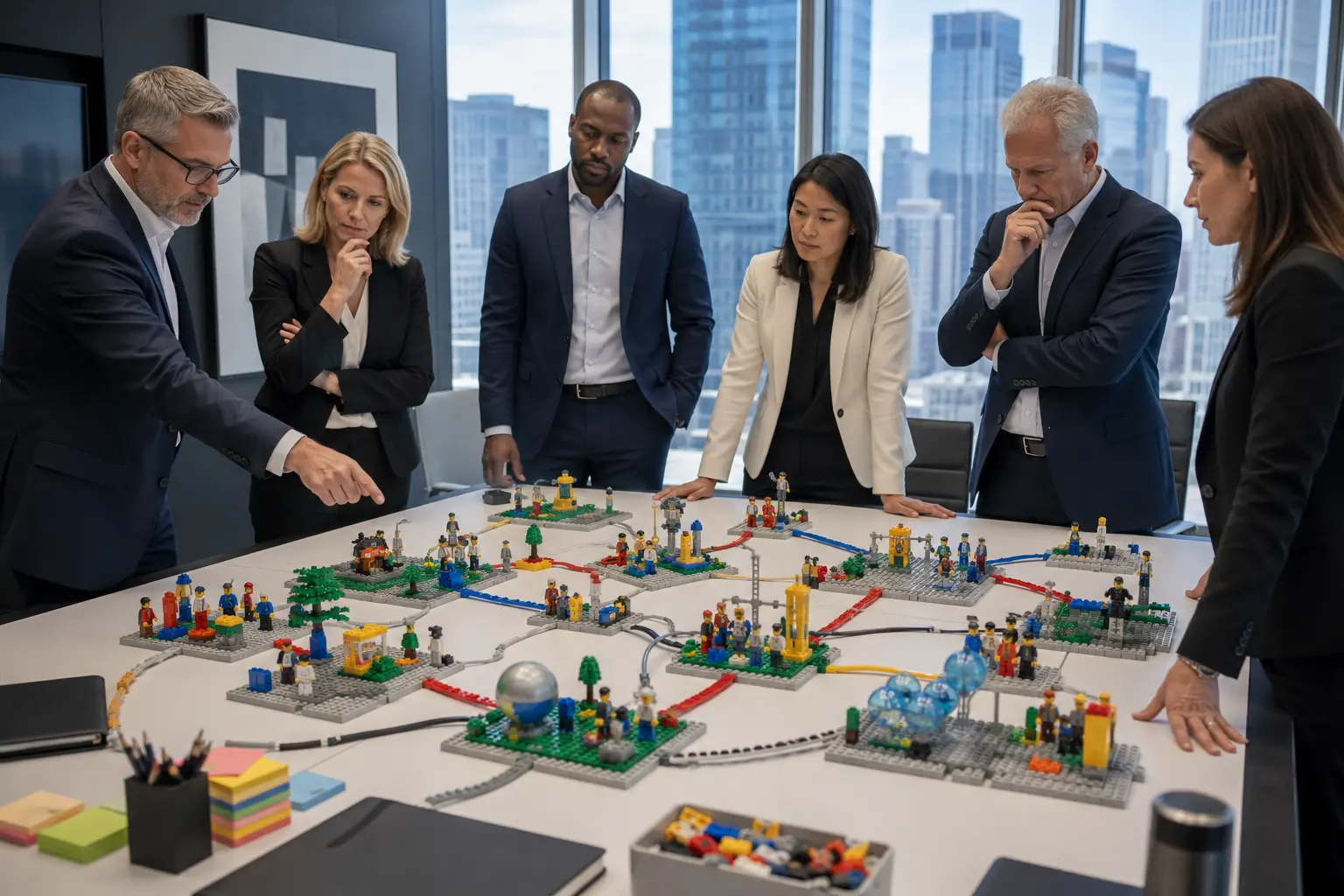
To picture certified facilitation at work, step through a typical strategy or alignment session. Notably, each stage is led with intention. In addition, it uses clear facilitator language and a defined purpose.
Click the ‘+’ button below to explore the detailed workshop stages.
1. Individual Challenge Build & 2. Storytelling
Step 1 — Individual Challenge Build (15–20 min): First, the facilitator sets out a specific challenge. Then each participant builds their own model in response. Because everyone builds at the same time, each person commits to a position before any conversation starts. As a result, the loudest voices no longer dominate early on.
Step 2 — Storytelling and Meaning Extraction (20–30 min): Next, participants take turns explaining their models. Meanwhile, the facilitator draws out the meaning with pointed questions. As a result, the group hears the reasoning behind every build, and quieter people are heard fully.
3. Shared Model Construction & 4. Strategic Reflection
Step 3 — Shared Model Construction (30–45 min): Then the facilitator guides the group in merging individual models into one shared model. At this point, connections, tensions, and dependencies surface. Consequently, the group starts to align around a single, jointly created picture of the challenge.
Step 4 — Strategic Reflection and Action Planning (20–30 min): Finally, the facilitator leads reflection on the shared model. In turn, insight becomes commitments. For example, the group names priorities, surfaces obstacles to execution, and agrees next steps everyone understands and owns.
Is LEGO® SERIOUS PLAY® Certification Right for You?
The certification pays off most for professionals whose work hinges on getting groups to align. In particular, it slots naturally into a range of roles.
- HR professionals shaping engagement, culture, and team-development sessions.
- L&D leaders building learning experiences that call for full participation.
- Consultants who want a repeatable way to surface a client’s assumptions.
- Agile coaches running retrospectives, planning, and team-alignment sessions.
- Leadership facilitators steering strategy and decision-making conversations.
- Transformation professionals leading change, where shared understanding decides whether a plan survives contact with delivery.
The Concrete Results of Better Facilitation
The worth of skilled facilitation should be judged by specific, observable shifts. In other words, vague pledges of “better communication” don’t count. Indeed, when a certified facilitator runs a well-built session, the results are tangible.
- Clashing assumptions come into view, so teams settle disagreement instead of carrying it forward.
- Leadership teams align around shared priorities they’ve co-created and can stand behind.
- Participation evens out, pulling input from everyone in the room rather than a vocal few.
- Barriers to execution appear before delivery starts, while they’re still cheap to fix.
Build Facilitation Skill That Holds Up
Maybe you’d like to experience a session for yourself. Or perhaps you want to design one around your team’s particular challenge. Either way, the next move is a focused conversation about what you need to align, decide, or build.
To understand the full methodology behind facilitator certification and workshop design, read The LEGO® Serious Play® Method Explained.
Frequently Asked Questions
What does LEGO® SERIOUS PLAY® certification involve?
It confirms that a facilitator has been trained in the method. In addition, they can design and lead structured, hands-on sessions. So the credential reflects a facilitation skill set. Specifically, it means bringing assumptions into view, driving full participation, and building shared understanding. By contrast, it is not a course checklist or a guarantee of expertise.
Is LEGO® SERIOUS PLAY® certification official?
Certification confirms training in the method. However, it does not mean a facilitator has been certified, employed, or endorsed by the LEGO Group. After all, LEGO® SERIOUS PLAY® is a facilitation methodology. Therefore, completing training in it creates no formal relationship with the toy company.
How much time does LEGO® SERIOUS PLAY® certification take?
Course length differs from program to program. However, the credential marks the start of a facilitator’s development rather than the end. Instead, real capability is built by running actual sessions repeatedly and reflecting on them. In short, that takes far longer than any single course.
Who is facilitator certification best suited to?
It fits professionals whose work depends on aligning groups. For example, HR professionals, L&D leaders, consultants, Agile coaches, leadership facilitators, and transformation professionals. In each of these roles, one skill is a direct advantage. That is, being able to run sessions where everyone takes part and assumptions become visible.
How does LEGO® SERIOUS PLAY® certification support organizational alignment?
It develops the facilitation skills that bring hidden assumptions into the open. Moreover, it turns separate viewpoints into one shared model the team co-creates. As a result, leadership teams align on real priorities. In addition, they catch barriers to execution before delivery begins, instead of running into disagreement mid-project.
This article is published by Serious Play Business. For current workshops, facilitator certification guidance, and the latest resources, visit seriousplaybusiness.com.