Last Updated by the Serious Play Business Content Team on August 21, 2026.
Picking a LEGO® SERIOUS PLAY® Training Provider: 7 Questions That Matter
Executive Summary
Nobody holds an official LEGO® SERIOUS PLAY® credential, because none is issued. The LEGO® Group opened the method’s core principles under a Creative Commons Attribution-ShareAlike 3.0 license on June 1, 2010 and wound down the partner network it had maintained until then. It has accredited nothing since. Whatever certificate you end up holding was awarded by a private company that decided for itself what earning it should involve.
Which puts the whole weight of the decision on the provider. Programs advertised in almost identical language routinely differ fivefold in teaching hours, in whether anyone reviews your work, and in what happens once you finish. Below: seven questions worth asking before payment, a scoring grid for comparing answers, guidance split by buyer type, and the warning signs of a shallow course.
Judge a LEGO® SERIOUS PLAY® provider on seven things: how long they have trained facilitators, what the lead trainer has personally facilitated, total teaching hours, whether an expert critiques a session plan you wrote, what support survives the end of the course, what the certificate demands of you, and what the whole thing costs once travel and lost days are counted. Nobody can sell you LEGO®-sanctioned certification — that stopped existing in 2010. The training behind the paper is the only thing that varies.
Nobody Issues Official LEGO® SERIOUS PLAY® Certification
Start here, because this one fact reframes every sales page you are about to read.
The 2010 change
Up to 2010 the LEGO® Group ran a network of licensed partners and facilitators, and using the method commercially meant paying for the privilege. That model ended on June 1, 2010, when the company shifted to a community-based approach and published the underlying principles and philosophy under a Creative Commons Attribution-ShareAlike 3.0 license.
In fact, two of the three original resource layers opened up — the principles and philosophy, plus the purpose-built brick sets. The detailed workshop roadmaps stayed out of the release. On its own background pages the LEGO® Group states directly that it has not run a partner network or offered facilitator certification since that date.
Why that matters to you
Training facilitators is open to anyone willing to respect the license conditions and the LEGO® Group’s trademark rules. Nothing sits above the market: no regulator, no accreditation council, no examining board.
Since then, practitioner communities have emerged — among them the Association of Master Trainers, Serious Play Pro, LSPConnect, and the Global Federation of LSP Master Trainers. They are networks, not authorities. A provider’s membership tells you about their professional circle, not about how well they teach.
The LEGO® Group has certified no facilitators since June 2010. Every credential now sold is self-awarded by the company selling it, which means the provider, not the certificate, is what you are buying.
Seven Questions to Ask First
Put these to everyone on your list, in writing. Providers with a solid program answer all seven concretely. Evasion on any one of them is itself an answer.
1. How many years have they spent training facilitators?
In practice, time in the market shows up as refinement. Run the same program for ten years and you have seen hundreds of graduates thrive or struggle, and rebuilt the curriculum around whatever keeps failing in live rooms.
Ask when facilitator training specifically began — not when the business was incorporated. Those two dates frequently diverge, and the distance between them reveals whether training is the core offer or a recent bolt-on.
2. Who runs the teaching, and what have they facilitated?
Running workshops and teaching others to run them are separate competencies, and you want both in the same person. Nobody who has avoided a room full of skeptical executives for three years can prepare you for one.
Get specific:
- Who wrote the curriculum, and who shows up for the live parts?
- Which organizations have they facilitated for, and how large were those groups?
- Who trained them in the method originally?
- Can you reach them during the course, or does everything route through junior staff?
3. How many hours of teaching do you get?
Of every variable in this market, this one swings widest and gets published least. Offerings run from a compressed two-day intensive to modular programs carrying 40+ hours of content.
Neither shape wins automatically, but the figure should be on the page. A provider unwilling to state total hours before payment has made a pricing decision, not an editorial oversight.
4. Will anyone critique work you produced yourself?
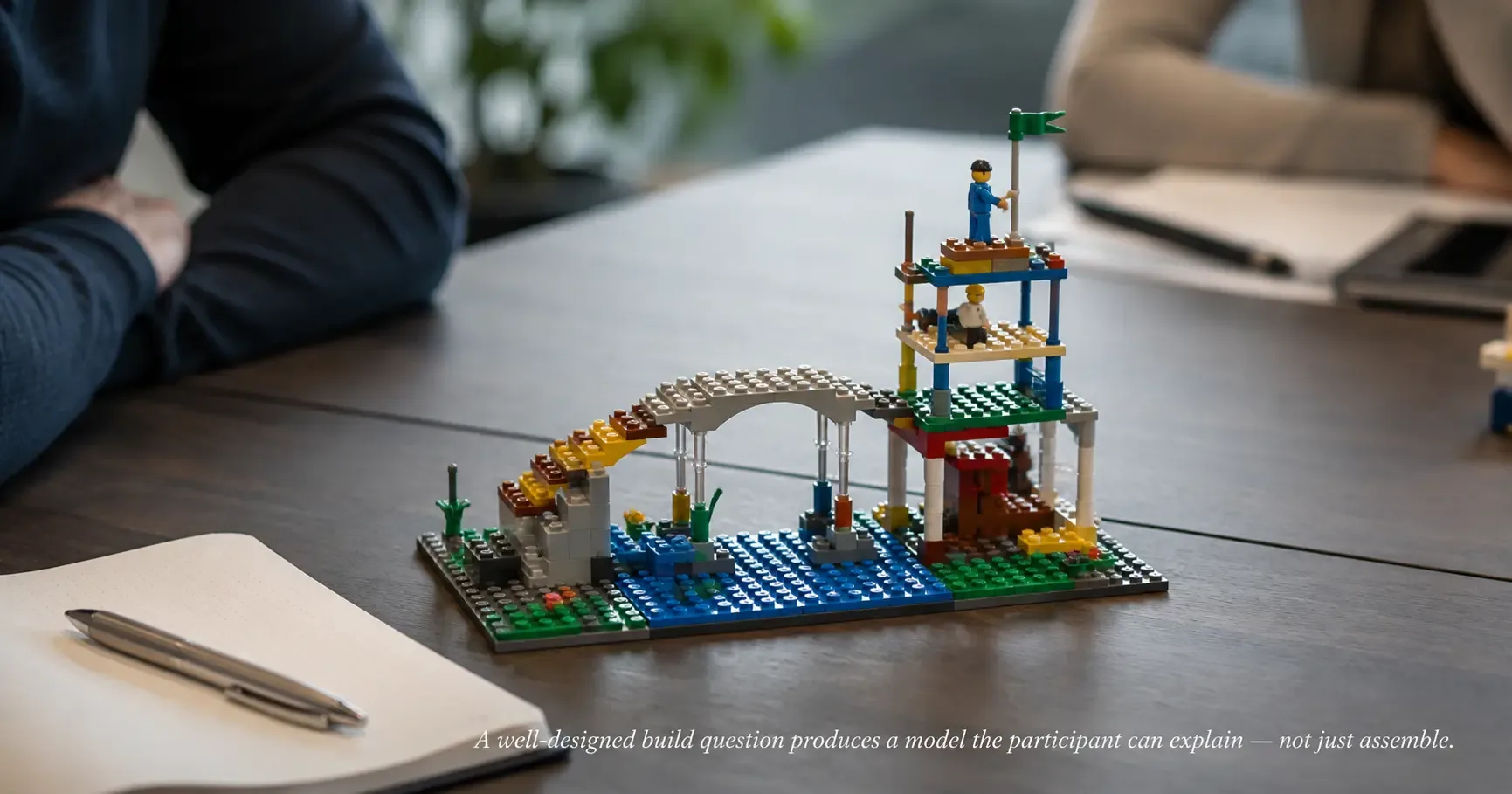
This separates serious programs from the rest more reliably than anything else. Watching video teaches you what the method is. Having someone dismantle a plan you wrote, for a team you genuinely work with, is what teaches you to facilitate.
So establish whether critique is included, who delivers it, how many rounds you get, and whether it arrives in writing or live. A forum login does not count.
5. What survives the end of the course?
In fact, hardly anyone facilitates their first real session during training week. It happens months later, when a stakeholder finally approves the budget — and that is when the questions start.
Ask how long materials stay accessible, whether templates and plans can be downloaded and kept, and whether the door stays open for questions after you are certified.
6. What is behind the certificate?
First, find out what you must actually do to earn it. Turning up is a different bar from submitting assessed work, and both get called certification.
Press equally on what the credential does not assert. Any provider hinting at LEGO® approval, LEGO® endorsement, or official recognition is describing a thing that has not existed for over fifteen years.
7. What is the real cost, all in?
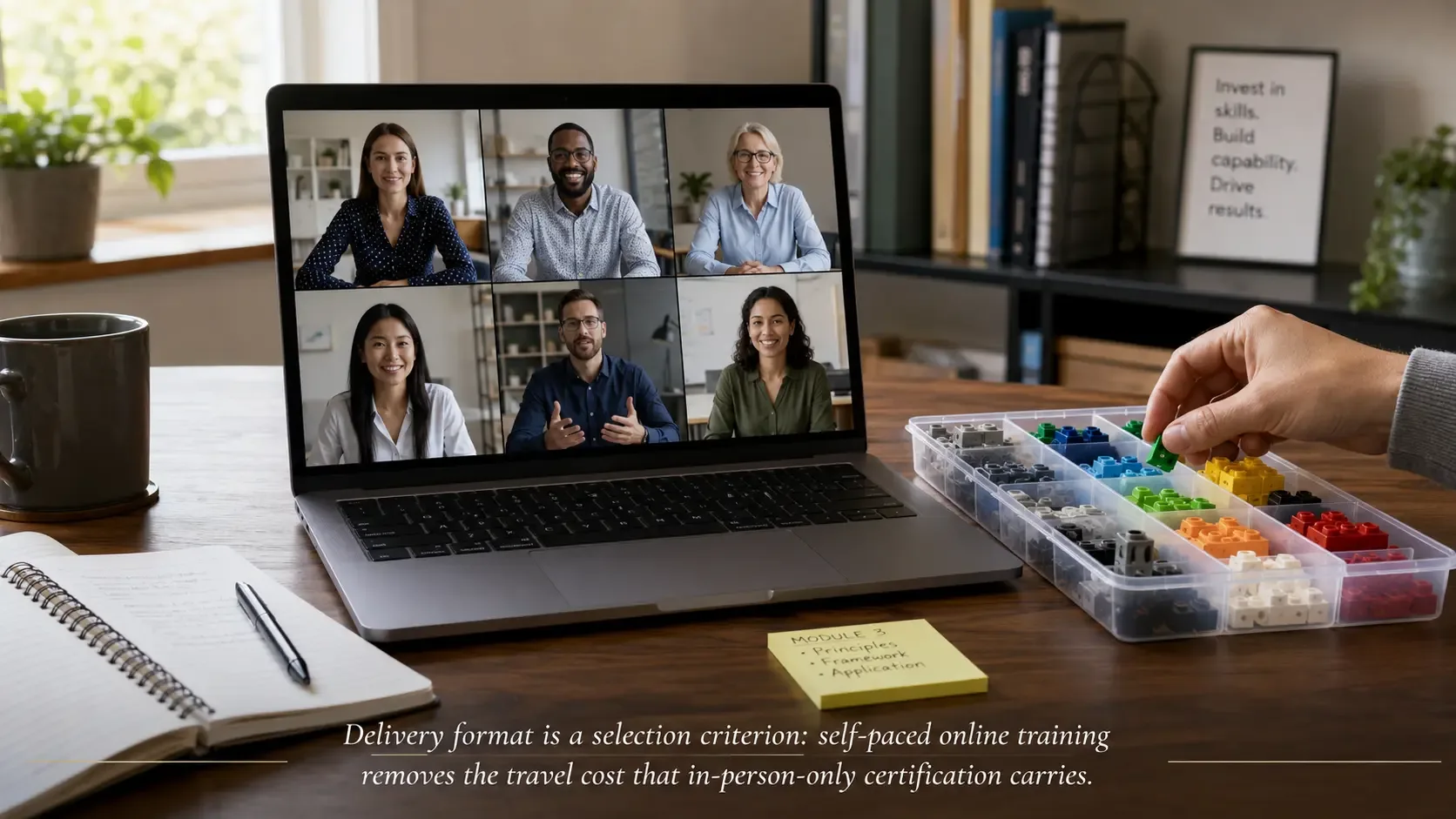
Finally, compare landed cost rather than headline price. In-person programs typically consume several working days plus flights and hotels, which can quietly outweigh the fee itself.
Total these six items for each option:
- The course fee, tax included
- Flights, accommodation, and meals for in-person attendance
- Working days surrendered
- Brick sets, where not supplied
- Any renewal or membership fee that recurs
- The cost of upgrading later if you begin at an entry tier
A Scoring Grid for Comparison
Rate every shortlisted provider against identical criteria, then weight the rows that actually bear on your situation instead of treating them as equals.
| What to check | Good sign | Warning sign |
|---|---|---|
| Years training facilitators | Ten-plus, published openly | Not given, or company age substituted |
| Lead trainer | Named, with a checkable track record | An anonymous “team of experts” |
| Teaching hours | Total published before checkout | Only ever called “comprehensive” |
| Expert critique | A named reviewer on work you wrote | Forum membership sold as support |
| How it is earned | Assignments submitted and assessed | Awarded for showing up |
| Access afterwards | Stated period, downloads included | Everything closes on the last day |
| Claims about LEGO® | Says plainly no official certification exists | Hints at LEGO® approval or backing |
What to Weight, Depending on Who You Are
Ultimately, the best fit depends on what you will be doing seven days after the course ends. Three buyer types dominate, and their priorities diverge sharply.
If you work in HR or L&D
Your sessions will mostly be internal — onboarding, culture work, team days — often with people who had no say in attending.
- Weight adaptable session plans you can turn around against an internal brief quickly
- Look for coverage of compressed formats, since full-length workshops rarely clear a corporate calendar
- Confirm you can download and keep materials, because internal programs get rerun
- Raise group pricing early if more than one person needs certifying
If you consult or coach independently
You are adding something billable to a practice, so client-facing credibility and your own composure in unfamiliar rooms both count.
- Weight expert critique and live practice above sheer volume of recorded content
- Ask whether commercial positioning — how to actually sell the method — is covered
- Treat peer network access as real value for referrals and co-facilitation
- Check whether you experience a full session from the participant’s chair
If you teach or research
You need the evidence base as much as the technique, and you are working inside a fixed timetable.
- Ask which peer-reviewed work sits underneath the curriculum
- Weight self-paced delivery that bends around a semester
- Seek material on compressing the method into class-length sessions
- Check whether the provider has trained others working in education
Signals Worth Pausing On
Of course, no single item here condemns a program. Two or more together should slow you down.
Assertions that cannot hold up
- Anything framed as LEGO®-approved, LEGO®-authorized, or officially recognized
- Wording that positions the provider as the sole legitimate source of training
- Suggestions that a license fee is owed to the LEGO® Group — none has been since 2010
Things left unsaid
- Hours, trainer identity, or full price withheld until after checkout
- Testimonials carrying no name, role, or country
- No plain statement of what earning the certificate requires
Structural thinness
- Nobody ever reviews work you produced yourself
- Materials vanish the day the course closes
- Ongoing fees required simply to keep calling yourself certified
Working Through the Evaluation in Five Steps
Overall, a structured comparison costs roughly a week of light work and reliably thins the shortlist. These five steps fall into three phases.
Click the ‘+’ button below to explore the detailed workshop stages.
Phase 1: Scope the Decision
1. Pin down your use case & 2. Assemble the shortlist
1. Pin down your use case (30 minutes): Write out the first three sessions you genuinely intend to deliver — who is in the room, how many, what question they are answering, how long you have. Almost every subsequent comparison resolves against this page. A provider that suits two-hour internal team sessions may be wrong for full-day executive strategy work.
2. Assemble the shortlist (1–2 hours): Pick three to five providers. Include at least one self-paced online option and one in-person option so landed costs can be compared honestly. Log each one’s stated hours, price, trainer name, and format in a single sheet before contacting anybody.
Phase 2: Ask and Compare
3. Send the questions & 4. Score what comes back
3. Send the seven questions (30 minutes): Email the identical seven questions to every provider on the list. Keeping the wording the same is what makes the replies comparable and exposes who answers straight. Log response times too — they preview the support you will get later.
4. Score what comes back (1 hour): Complete the grid above. Weight each row against your use case page rather than scoring everything equally. Where a provider skipped a question, record it as skipped rather than quietly assuming a middling result.
Phase 3: Verify Before Paying
5. Check independently before committing
5. Verify independently (1–2 hours): Look up the lead trainer’s professional profile and published work. Find named graduates and message one or two — most will answer a short, specific question about whether the course readied them for live sessions. Get the full cost confirmed in writing, including anything the fee excludes, before paying.
Our Own Answers to the Same Seven
So here are the same questions, turned on ourselves and answered with specifics.
Track record and reach
Serious Play Business sits within The Focus Learning Group Pty Ltd, established in Sydney, Australia in 2008 and renamed from Play4Business in 2024. Nineteen-plus years have gone into refining how we teach the method, and over 1,800 facilitators, consultants, and academics across 38 countries have come through our programs.
Our founder, Dr Denise Meyerson, was appointed by the LEGO® Group as one of the original four Master Trainers of the method and has held that role since 2010. She is also a Master Trainer with the Association of Master Trainers. Organizations we have worked with include Virginia Commonwealth University, Miami University, Capgemini, Kaiser Permanente, Syngenta USA, the US Air Force, the US FCC, and the Metropolitan Council of Minnesota.
What the program contains
Foundational Certification carries 40+ hours of curated material and recorded live sessions, a one-to-one Q&A with tutor feedback, three session plans ready to run, bonus modules on marketing and academic application alongside the “What the Duck®” short-format methodology, and twelve months of access to every resource and downloadable template.
The certificate follows completion of 10+ modules and two submitted assignments — attendance alone does not earn it. Advanced Certification layers on two 2-hour live sessions covering advanced technique, entry to a global facilitator network, and a full session experienced from the participant’s side. The thinking behind all of it is set out on our methodology page.
More than 1,800 facilitators across 38 countries have trained with Serious Play Business over 19+ years, with certification granted on assessed assignments rather than attendance.
Price and format
Foundational Certification is US$750; Advanced Certification is US$1,300. Both run fully online and self-paced. With no travel and no time away from the desk, list price lands close to true cost — which is exactly the comparison to make when an in-person alternative is on the table.
The pricing reflects a deliberate stance: this method should reach further than the handful of buyers who can absorb premium fees. Both tiers are laid out on our certifications page, and the organizations our facilitators work with are listed on our clients page.
On certification itself, we hold ourselves to the standard we are recommending: no program in this market carries LEGO® Group approval, and that includes ours. What we offer instead is depth, assessed work, expert feedback, and 19+ years spent doing nothing else.
Ask Us the Same Seven Questions
Bring the list. We will answer every one in writing, tell you honestly whether our program suits the sessions you plan to run, and say so if it doesn’t.
To understand the full methodology behind the workshop design described above, read The LEGO® SERIOUS PLAY® Method Explained.
Frequently Asked Questions
Comparing providers
How do I compare LEGO® SERIOUS PLAY® training providers?
Assess seven things: years spent training facilitators, who teaches and what they have facilitated, total teaching hours, whether an expert critiques work you wrote, what support continues afterwards, what earning the certificate requires, and full cost including travel and days lost. Send the same questions to everyone and compare the replies side by side.
Credentials and the LEGO® Group
Does the LEGO® Group approve any facilitator certification?
No. On June 1, 2010 the LEGO® Group moved the method to a community-based model under a Creative Commons Attribution-ShareAlike 3.0 license and closed its licensed partner network. It has not offered or accredited facilitator certification since. Every credential on sale today is awarded by a private company on its own authority, so claims of official approval are simply wrong.
How much experience should a facilitator trainer have?
No threshold exists, but ask when they started training facilitators rather than when the company was founded. Providers past the ten-year mark have usually rebuilt their curriculum repeatedly around what fails in live rooms. Read the years figure alongside graduate numbers and countries covered, since a long history with few graduates says something different.
What does Master Trainer mean in LEGO® SERIOUS PLAY®?
It denotes someone qualified to train facilitators rather than only to run sessions. Four Master Trainers were appointed by the LEGO® Group around the time the method opened up, and community organizations such as the Association of Master Trainers now certify their own. With no single governing body, ask any provider where their Master Trainer status originates and what it took to obtain.
Cost and getting started
Why is there such a wide price range between providers?
Most of the spread comes down to format, teaching hours, and how much one-to-one expert time is bundled in. In-person courses carry venue and trainer travel costs and oblige you to fund flights, hotels, and absence from work. Self-paced online programs strip those out, which is why sticker price compares badly — build the landed cost for each option first.
Is prior facilitation experience required?
Not for most foundational programs, ours included. Being clear about the sessions you intend to run matters far more, since that determines which provider fits. With no facilitation background, weight expert critique and assessed assignments heavily — those are what turn knowledge of the method into the ability to hold a room.